Showing posts with label math. Show all posts

Saturday, October 27, 2012

Making a Square out of Circles

Let's say you're a marine biologist, and you've recorded a bunch of whales and dolphins, and you want to study the sounds that they're making.  Some of the cetacean species you've recorded will be making sounds too high for you to hear (like porpoises and beaked whales), and some will be much too low (like blue whales).  In addition, some biologists (like the ones who are older or have attended too many KISS concerts, might not be able to hear very well at all.

One of the ways biologists get over this is by turning the sounds into pictures, like this picture of a dolphin whistle:

This is called a spectrogram.

Here, we can see that the whistle starts out high, and then drops down in frequency, and goes back up again. Frequency is on the y axis.

Remember, loud sounds have high amplitude (shown as a darker red in the spectrogram above), and high frequency sounds have a high frequency (which will put them high on the y axis of the spectrogram).


This transformation between sound and picture is done via something called the Fourier equation.  The Fourier equation is really cool - it takes a complex sound, made out of multiple different frequencies, and breaks it up into the component frequencies.  It's kind of hard to picture this happening, so I decided to start with a simple single-frequency sound, and make it into a complex frequency sound, so we could see what was happening in the reverse.

So what complex sound can I make from simple sine waves?  What about a square wave?

Figure from Khin Hooi.

Click here to listen to a square wave.
Single frequency sounds are composed of pure sine or cosine waves, which are rounded like this:


However, we can create a square wave by adding additional frequencies, each one of which is an odd harmonic frequency of the original sine wave, and which is smaller in amplitude by a specific amount. For example, in the first step to making a square wave, we would add sin(3*t)/3 to the original equation for the sine wave, y=sin(t).  Then we would add sin(5*t)/5, sin(7*t)/7, sin(9*t)/9, and so on for the odd numbers until the wave is square enough to make us happy. Here's an animation of the frequencies being added up to make a square wave:


Cool, so now we've made a sound out of a bunch of different frequencies.  The next thing to do is to use our Fourier transform on it, to take it back apart again.

The figures on the left are of the square wave I've created, and on the right are of the Fourier spectrogram of that wave.  In the first row of figures, you can see that there is only one frequency, and the spectrogram only shows one line (the light blue one at the bottom). As I add more frequencies, more and more (lighter and lighter) lines appear on the spectrogram.
I thought this was a pretty good demonstration of how Fourier Transform works. We've made a complex signal, and then Fourier helped us take it back apart again so we could visualize the different sine waves that make up the signal again.

If you can't get enough of this stuff, here's an excellent post I found about building a sawtooth wave.

Also, here's a great little youtube animation of the making of a square wave:


If you have matlab, and want to try this out, email me for the code.

Tuesday, September 18, 2012

Why Can't We Directly Compare Sounds in Water and Air?

One of the biggest, and most common, mistakes that people make when writing about underwater acoustics is making direct comparisons between the loudness of things in water and in air.  Here's an example of something that you might read about underwater sound:

"The bottlenose dolphins were being exposed to sounds up to 160 dB.  That's  louder than a 747!"


Well, actually, it's not.   

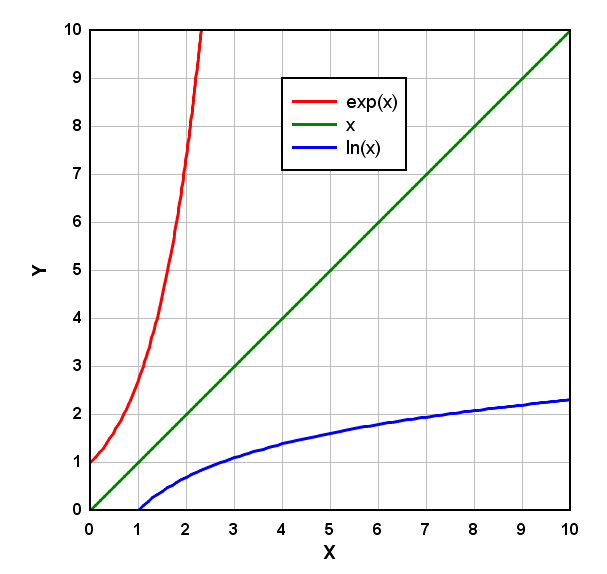
The problem here is related to the units with which we measure sound. First of all, we measure sound using the decibel.  Decibels are logarithmic units. Basically, logarithmic scales allow us to make big numbers smaller so that they are easier to visualize. For example, in the chart below, you can see that when we take the log of value for x (in green), the log values (in blue) are decreased more for large values of x than for small values of x. The opposite is true of taking an exponential of x, such as x^2 (in red).


Why make things so complicated when we talk about sound? Well, human beings actually perceive sound pressure in a log scale.  For example, you wouldn't really be able to tell the difference in loudness between 6 trumpet players and 7 trumpet players, because your brain doesn't process sound lineally. In fact, every time you want to change the loudness level by just three measly decibels, you have to double the power.  So, if you want to increase the loudness of your trumpet players by 3 dB, you'll need 6 more trumpets.  

Doublemint gum only makes you 3 dB louder, just ask the dolphins.

OK, so now we understand decibels, why can't we compare dB in air with dB in water?

First of all, decibels must always be referenced to some standard. In air, decibels are referenced to 20 micropascals (pascals are a unit of pressure). In water, they are referenced to 1 micropascal.  This means that, from the start, 26 dB must be added to the sound level to make the two references levels the same.

Secondly, water is much denser than air, so the effects of pressure are also different. Although it is possible to compress water, it is much more difficult to do so.  In fact, when we add the difference in densities between air and water into the equation, we find that the sound pressure in water is 60 times greater (or 35.6 dB higher) than the same value in air.

Loud, but not as loud as a plane. Photo from the CRRU.
So, if white-beaked dolphins are producing whistles that are between 139 and 148 dB, that doesn't mean that they are making sounds louder than a 747. If we convert those numbers to values in air, we get somewhere between 103 and 113 dB.  Which is still pretty darn loud, but not quite as loud an airplane engine.  It's also good to point out that dolphin whistles are "narrowband" sounds. I explained narrowband in an earlier blog post, but basically what this means is that you can't imagine a whistling dolphin sounding like a jackhammer, because the sounds cover a very different range of frequencies and are produced by very different mechanisms.

So, next time you read something comparing underwater sound compared to sound in air, check to see if they did their conversions right!

Monday, September 17, 2012

A wave is a complicated thing to equate

I am only studying chapter 1.2.1 of my big scary bioacoustics book, and already I'm running into some scary maths (tm). However, my advisor has told me that I don't have to actually know how to derive the equations, just understand them conceptually (Apparently I am getting my PhD in Zoology and not Electrical Engineering - could have fooled me!).

I use sound to study whales in the ocean. Understanding sound is absolutely essential to my research, and to understand sound, you've got to understand the wave equation.

We're not going to actually derive the wave equation, but it's important to know what goes into it. (if you want to see the real math, look here). In order to understand waves, you need to understand four other fundamental laws. The great thing about these laws is that they pretty much are telling you that waves obey the laws of physics. By the combined powers of these laws, Captain Wave equation emerges!

Conservation of Mass: This means that even though the number of molecules in any part of the volume that  sound passes through may change, the total number of molecules in the volume stays the same.

In the sound wave, molecules get more
compressed, but don't appear out of thin air. 

Equation of Motion (Newton's Second Law): This means that we can calculate the force acting on particles by multiplying their density when a sound is passing through them by their acceleration.

Force = Acoustic Density * Acceleration

Equation of Force: With this, we can use the total density of the fluid (which is different from the acoustic density) and divide it by the x movement of the particles to find the force acting on the particles.

Force = Total Density differential * x differential
Equation of State: This tells us that acoustic pressure is related to how easily the medium through which a sound travels is compressed. Some people think that liquids and solids can't be compressed, but this isn't true. The reason we generally consider liquids to be incompressible is that it is REALLY REALLY hard to compress a liquid. I couldn't do it, even if I worked out a LOT.  However, liquids at the bottom of the ocean have the weight of tons of water sitting on top of them.  The weight of all this water presses down on the liquid, pushing the molecules closer together. In fact, if you have enough pressure, you can even compress rocks. Here's my version of this equation:
Pressure = (squishiness / acoustic pressure) * pressure

When you put these four equations together, you get the wave equation, which uses all four to describe the movement of a wave. This equation factors in pressure, time, the speed of sound, and the movement of particles.

Why is this important to a whale researcher?  Well, if I want to use sound to study animals underwater, I need to understand that sound travels differently in different types of water. In the ocean, things that might change how sound travels are depth, salinity, and temperature. If, for example, a beaked whale is clicking at 5000 m, and I am recording it at the surface, I can't assume that the sound is traveling in a straight line from the whale to me. As the depth and temperature changes, the way sound moves through it will change. I need to be mindful that these things can change how sound moves through the water.

I warned you this was going to be dense. And that was only chapter 1.2.1.

Also, if I made a math mistake, and I messed up on understanding any of the equations, please comment!


Tuesday, May 8, 2012

We Should Have Studied Dolphins in High School Math

When I look back at my educational career, it's really striking how poor of a student I was.  That is, I was a pretty mediocre student in the "hard" sciences until I took Marine Biology class during my senior year of college.  Most of the time, I think I was just really bored.  It wasn't always because the material wasn't challenging or useful (although sometimes this was the case). It was often because I had no idea what the point of it was.  OK, so in physics we could calculate where a ball would land based on the angle and force.  I only played baseball when forced to in gym class, and when I did I had no control over the force and angle of my wild swings.  I didn't have a home catapult, and I just didn't get how this stuff could really matter to ME.

It wasn't until I got really interested in marine biology, and specifically whale and dolphin bioacoustics, that I started seeing how amazing and cool math & physics can be.  If you read my blog, you know that bioacoustics is the study of the sounds of living things.  Whales and dolphins use sound to communicate and find food underwater, so even if you can't see them, you can very often hear them.  Some whales, such as beaked whales, are actually easier to find by listening than by looking with your eyes.  In addition, sound travels further underwater than light, so people at the surface can even hear whales that are thousands of feet underwater, or even hundreds of miles away. We can use these sounds to track the location of the animal, and we can do it using high school math.  Super cool.

Why didn't we do this in my high school trigonometry class?

It's really pretty simple.  First, you need something in the water making a sound.  Let's say... a whale.


Then you'll need a boat and something to record the sound.  We're going to use a hydrophone array, which is made up of three underwater microphones (hydrophones) strung in a line, with 15 meters between each hydrophone.  


When the whale makes a sound, it travels in a straight line through the water* to each hydrophone, arriving at the closer hydrophones sooner and arriving at the further hydrophones last.  Let's say the sound arrives at our recordings at time 0 for hydrophone 1, 0.006 seconds for hydrophone 2, and 0.0007 seconds for hydrophone 3.


How on earth do we figure out the distance to a whale when all we know is the difference between when we heard it on hydrophones 1, 2, and 3?  Easy - there's a simple equation for that!


The sound speed in water is 1500 m/s (which is why I put the hydrophones 15 m apart - to make the math easier).


We've replaced some of the words with numbers, something I HATED in high school.  Oh wait, I still hate it, so I'll just explain what the equations mean: The time difference between hydrophone 1 and 2 (t21) is equal to the difference between the distance between the whale and hydrophone 1 and the distance between the whale and hydrophone 2 (d2-d1) divided by the speed of sound.  Holy mother of god, this is just geometry!  I could have been doing this when I was 15! Some of you over-achiever types probably took geometry in 8th grade, so you could have done this when you were 14. Not me!

With a little algebraic rearrangement (which I am not going to bore you with, since you can look it up here), we get:

**


Sx and Sy are the x and y locations of the whale. C the speed of sound in salt water, 1500 m/s.  dh is the distance between the hydrophones, which in this case is 15 m, and all the ts refer to the time difference between the hydrophones (the small numbers tell you which two hydrophones: t21 is the difference between the arrival at hydrophone 2 and 1, etc).  All you have to do now is plug in the numbers. Edited 5/12/2012: To make it even easier, I've provided a spreadsheet here.


**


Then you can graph the location of the whale (-16.7, ±241.7), along with the locations of your hydrophones at (0, 0), (0, 15), and (0, 30).  I've just made designated hydrophone 1 at (0, 0) to make things easy, but in real life you'd have a GPS on the boat and you'd have to add the length of the hydrophone cable to the location of the boat's gps.


You might notice something funny about this equation - it actually gives two solutions - one on either side of the line of hydrophones.  That's a big problem with using three (or four, five, etc.) hydrophones in a row - you're not really sure what side of you the whale's on.  The reason for this is that there are two possible solutions for Sy. However, you can figure out which side the whale is on by turning the boat.  The location that stays in relatively the same place regardless of where the hydrophones are is the correct one.  Other ways to fix the left-right ambiguity? Make your hydrophones into a 2D shape (hard to do when dragging them behind a boat because 2d shapes are not very streamlined)*** or use DIFAR.

I wish I had done this kind of math in high school - it is totally within the realm of a high school student!  I think I might have paid better attention to something cool like finding whales.  On the other hand, maybe not.  That boy across the room WAS pretty dreamy.  Not all kids will be interested enough in whales and dolphins to get interested in math and physics, but the cool thing about math and physics is that, regardless of what you're into, I bet it applies.  From video games to raising miniature ponies, there's math in there somewhere.  Sometimes it just takes the right spark to get people interested.

P.S. If I made any mistakes above, please call me out.  Like I said, I didn't do so well in math class.  Also, if you're interested in a copy of the xcel spreadsheet with the equations already in it, shoot me a message and I'll send you a copy.


* This isn't always the case - sometimes the sound bounces off the bottom or the surface to get to the hydrophone, but I'm ignoring those cases here for simplicity.

** Edit: May 9, 2012. I made a HUGE mistake the first time I posted this and completely ignored the equation for t1 (I thought t1 was a typo for t12).  This is now fixed.

*** Edit: May 8, 2012.  Changed "3D" to "2D" because of a comment from Sam Denes. I had thought a straight line was already 2D, but apparently a straight line is 1D and adding another point off the line makes something 2D.

Note: I got to talk to a bunch of high school math teachers about this math.  Recap here.