Showing posts with label dolphin. Show all posts

Tuesday, September 18, 2012

Why Can't We Directly Compare Sounds in Water and Air?

One of the biggest, and most common, mistakes that people make when writing about underwater acoustics is making direct comparisons between the loudness of things in water and in air.  Here's an example of something that you might read about underwater sound:

"The bottlenose dolphins were being exposed to sounds up to 160 dB.  That's  louder than a 747!"


Well, actually, it's not.   

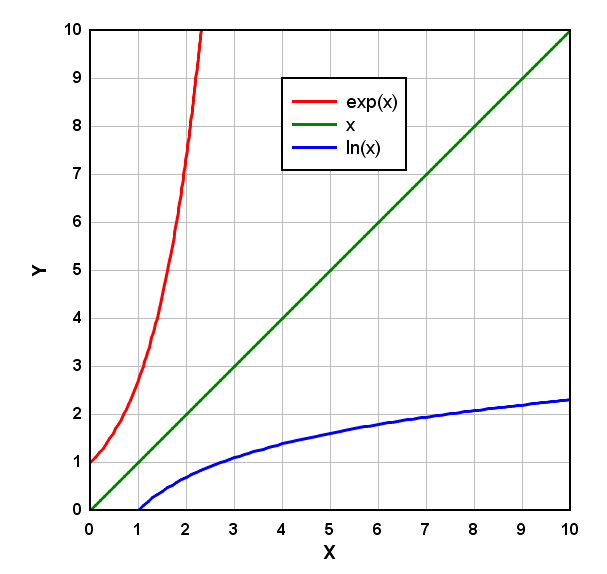
The problem here is related to the units with which we measure sound. First of all, we measure sound using the decibel.  Decibels are logarithmic units. Basically, logarithmic scales allow us to make big numbers smaller so that they are easier to visualize. For example, in the chart below, you can see that when we take the log of value for x (in green), the log values (in blue) are decreased more for large values of x than for small values of x. The opposite is true of taking an exponential of x, such as x^2 (in red).

Why make things so complicated when we talk about sound? Well, human beings actually perceive sound pressure in a log scale.  For example, you wouldn't really be able to tell the difference in loudness between 6 trumpet players and 7 trumpet players, because your brain doesn't process sound lineally. In fact, every time you want to change the loudness level by just three measly decibels, you have to double the power.  So, if you want to increase the loudness of your trumpet players by 3 dB, you'll need 6 more trumpets.  

Doublemint gum only makes you 3 dB louder, just ask the dolphins.

OK, so now we understand decibels, why can't we compare dB in air with dB in water?

First of all, decibels must always be referenced to some standard. In air, decibels are referenced to 20 micropascals (pascals are a unit of pressure). In water, they are referenced to 1 micropascal.  This means that, from the start, 26 dB must be added to the sound level to make the two references levels the same.

Secondly, water is much denser than air, so the effects of pressure are also different. Although it is possible to compress water, it is much more difficult to do so.  In fact, when we add the difference in densities between air and water into the equation, we find that the sound pressure in water is 60 times greater (or 35.6 dB higher) than the same value in air.

Loud, but not as loud as a plane. Photo from the CRRU.
So, if white-beaked dolphins are producing whistles that are between 139 and 148 dB, that doesn't mean that they are making sounds louder than a 747. If we convert those numbers to values in air, we get somewhere between 103 and 113 dB.  Which is still pretty darn loud, but not quite as loud an airplane engine.  It's also good to point out that dolphin whistles are "narrowband" sounds. I explained narrowband in an earlier blog post, but basically what this means is that you can't imagine a whistling dolphin sounding like a jackhammer, because the sounds cover a very different range of frequencies and are produced by very different mechanisms.

So, next time you read something comparing underwater sound compared to sound in air, check to see if they did their conversions right!

Thursday, August 16, 2012

What is looking for dolphins in the ocean really like?

Many people are curious about what it is like to be out on a boat looking for dolphins in Hawaii. Lots of people think it's easy - my job is simply to sit on a boat and watch dolphins. Many people have a hard time believing that you can actually get paid to lounge on a boat and watch dolphins frolic in the surf.  The reality is a lot more complicated.


This is not what I look at all day (photo from FIRMM.org).

Finding dolphins, especially in Hawaii, can be really time consuming and difficult. Especially if you are interested in the types of dolphins that don't generally hang out near shore, which is most Hawaiian species (the exception being spinner dolphins).

Searching for dolphins at sea requires something called a "search image." Visual predators use search image all the time to find food. For example, blue jays look for the color, shape, or pattern of a moth to find their food. Prey can also use a search image to look out for predators: sea lions also use a visual search image to watch out for hungry killer whales.  If a killer whale doesn't match their search image - for example, by having a weird, bent over dorsal fin - sea lions don't always recognize it as a threat.

Biologists also use search images. Bird biologists look for something moving against a still background. Snail biologists look for a round, white spiral in a sea of shaking green leaves. And dolphin biologists look for moving triangles (dorsal fins) in a sea of other moving triangles (waves).

Lots and lots of blue-gray triangles. But which is a dolphin?
Photo by Alexis Rudd, 8/15/12.
Looking at waves is a lot like looking at the ants on a tv screen.  It's kind of like watching random noise (although obviously I am oversimplifying things to give you an idea, waves aren't really random).

So, most of the time, when whale and dolphin observers are  looking at the ocean, it's like looking at this (you might want to adjust your screen so you can only see one of these .gif files at a time - it's making me kind of queasy):


When a large whale comes along, the observer sees a shape in the noise that isn't changing for a little while, like this:


Did you find the "whale?" Hint: it's the blacker spot that appears in the bottom right hand corner for about 3 seconds.

Dolphins are even harder to see, because they move faster. When a scientist is searching for a dolphin, they look for a shape that isn't changing very much, but might be moving across the waves.  Can you spot my "dolphin?"


That one's kind of hard (I am having trouble, and I made the thing!), so I made the "dolphin" pink.  Now can you see it?


This week, I've been out on the water on the big island, helping look for whales and dolphins. We usually get out on the water at about 6:00 am (sometimes a little earlier) and come back in at 3:00 pm (if we're lucky unlucky). For the last two days, we have seen two groups of animals per day. That means that we have effectively been staring at noise for about 8 hours, searching for that tiny little clue that will tell us where the dolphins might be.  Coastal cetaceans are not spread out as much as in the tropics, so there is not always as much time staring at noise.

Isn't the human brain an amazing thing? It can pick up a tiny difference in pattern -

"That bit of the ocean isn't moving as much as the other bits!"

out of an enormous amount of noise. There isn't much on earth that's more enormous than the ocean.


Tuesday, June 5, 2012

What You Know* About the Difference in Dolphins and Porpoises is Wrong**

*Mostly  **Some of the time

Last weekend I was lucky enough to speak at a math workshop for high school teachers put on by some of the University of Hawaii Match Department faculty.  And let me just start out by saying that it was AWESOME.  As anyone who has ever read "How to Win Friends and Influence People" knows, one of the best ways to get people to like you is to ask them questions about themselves.  For scientists, this extends to talking about our research. Beware asking a scientist good, intelligent questions about their work: you may be there for hours!

So, talking to the math teachers was an incredible treat.  They asked great questions, including one of my favorites, "What's the difference between a dolphin and a porpoise?"  Porpoises are from the cetacean family Phocoenidae, while dolphins are in the family Delphinidae.  I love this question, because there are so many misconceptions about what makes a porpoise.  This cartoon does a great job of showcasing those misconceptions:


Let's get the easiest misconception out of the way first: size.  I'll admit the average weight of porpoises is less than the average weight of dolphins.  However, there are many examples in which this just isn't true.  For example:

Dall's Porpoise (up to 200 lbs)

Hector's dolphin (up to 125 lbs)

So size of the animal isn't exactly the best diagnostic to use when deciding whether something is a dolphin or a whale.  How about rostrum (head) shape?

  Risso's Dolphin by Greg Boreham                             Finless Porpoise

Hmm, one of those is a dolphin and one is a porpoise, but they seem to actually have very similarly shaped heads.

OK, FINE! But if it has a bottlenose like Flipper, we DEFINITELY know it's a dolphin, RIGHT?

Northern bottlenose whale  (Hyperoodon ampullatus, in Family Ziphidae)

ARGHHHH!  It must be the fins, then. Dolphins HAVE to have pointy dorsal fins (the one on their back), and porpoises have rounded fins!

Chilean dolphin (rounded)                                                      Dall's Porpoise (pointy)

No dorsal fin at all (Southern Right Whale Dolphin).
The finless porpoise also has no dorsal fin, as the name implies.
OK, I give up, there must be SOMETHING I can use to figure out whether this random cetacean I got in the mail is a dolphin or a porpoise - but what????

TEETH!

Bottlenose dolphin                                |                             Harbor Porpoise
Dolphins have cone-shaped teeth throughout their mouth, while porpoises have what are known as spade-shaped teeth.  Here's a comparison, with A being the porpoise tooth and B being the dolphin tooth.


Dichotomous keys are tools that scientists use to figure out what species they are looking at.  These keys are kind of like those "build your own story" books that you had when you were a kid. You are asked a series of questions, and the questions lead to an ending.  It's also a lot like 20 questions, with each question further narrowing down the possibilities of which species you could have.  In fact, if you were using a dichotomous key to determine the species of a cetacean, the tooth question is what separates the porpoises from everything else.  


Try keying out whale, dolphin, and porpoise species
at the Marine Species Identification Portal!
In general, can you use these rules to distinguish between a dolphin and a porpoise?  Sure you can. But it's important to be aware of the many exceptions. Let's be honest, the likelihood of encountering Dall's Porpoise (found on the US west coast) and Hector's Dolphins (found in New Zealand) on the same day is infinitely small.  Even smaller is the likelihood that they'll give you a good look at their teeth. The best plan is to be knowledgeable about the species you are likely to encounter in your area.

Thanks for the great questions, Math Teachers of Hawaii.  If you'll notice, I haven't actually given much space to the actual workshop.  I'll get to that later. See what happens when you ask a scientist about something that interests them?!

If you ask a scientist a question...
they'll want a cookie.

Who am I kidding, I always want cookies.

Monday, March 12, 2012

Turning Whalesong into Rainbows: 1000 Numbers to 1000 words

Art by Casey Roberts
Two weeks ago I wrote about how sound gets from a whale, and into your computer.  At the end of that post, I included a pretty rainbow-colored picture of some dolphin whistles.  But I didn't ever explain how all that digital data got translated from zeros and ones into a nice pretty picture.


Why are pretty pictures important to science?  Awards are given out every year by several prestigious groups for the best images in science and biology.  These images are not only beautiful, but they often help us understand complex concepts that are difficult to understand using words alone.  For instance, I can tell you that dolphins have fat deposits in their jaw bones that help transfer sound into their ears, but the following picture by Darlene Ketton's lab at Woods Hole really shows you how the auditory fats (orange) connect up with the inner ear bones (red) to help the dolphin hear.  This picture does a better job of communicating the concept than I could do in 1000 words, AND you're not bored to death, either.


A 3-D image generated from a CT scan highlights selected
 tissue groups of a bottlenose dolphin's head. 
 (Courtesy of Darlene Ketten, WHOI)
Humans process most of their information visually, so we often need to translate acoustic information into visual information.


The acoustic data that I collect in my research is stored as binary data, which means that it is stored as a bunch of ones and zeroes, like this: 


01001000 01100101 01101100 01101100 01101111 


Each of these sets of ones and zeros corresponds to a letter or a number (the code I just used says "Hello"). Unfortunately, I can't look at binary code and understand what it means, because I'm not Neo from the Matrix.  Alas!


However, my computer understands the language of binary, and it translates all of these ones and zeros into slightly shorter strings of numbers, which look something like this (except a whole lot longer):

0.000113379 0.000136054 0.00015873 0.000181406 0.000204082 0.000226757

Not really a whole lot better, is it?  

2-D

Fortunately, I know that these random-looking numbers are the pressure values for a sound wave that has been measured 80,000 times every second. This means that the first number has a time value of 0, followed by 1/80000, 2/80000, etc.  Now that I know what the time values are, I can make graph with time on the x axis and the value for pressure on the y axis, like so: 

This is better: I can see that the sounds get louder and softer over time.  If the sound is louder, it will make bigger bumps on the graph, and if it is quieter, the bumps will be smaller.  It's still pretty hard for me to pick out the different sound frequencies, or pitches.

I can kind of see what is going on here, but it is like looking at only one line of pixels from an image of Marilyn Monroe; I don't really know what is going on [A]:


Fortunately for me, a French mathematician named Jean Baptiste Joseph Fourier (1768-1830) figured out a way to represent a continuous periodic signal (like a sound wave) as the sum of a bunch of sine waves.  This means that I can break up the signal above into a lot of simple sine waves.  I can also do the opposite, by adding up a bunch of simple sine waves to create a complicated one [B]:
Adding two sine waves together.
The top four waves combined (light blue) create the more complex wave at the bottom (dark blue) 

Even REALLY complicated waves, like this one, can be created by combining fourteen simpler waves:


2-D Again - Frequency

Once we break the sound up into its component frequencies, we can create a different picture.  This picture looks at how much of the sound is made up of each frequency.  For example, in this picture we are looking at the relative contributions of different frequencies to a sound recording.  You can see that there are more low sounds than high sounds, and that there are two small "peaks" between the frequencies of 1250 Hz and 1500 Hz.  (Hertz measures the frequency of a sound.  You can hear between 20 and 20000 Hz, depending on your age.) These two small peaks are actually the two frequencies at which the humpback whale is singing at this particular moment in time.

Now, it's like I'm looking at that picture of Marilyn vertically, but still only one row at a time.


Let's recap: To make a picture of a whale song, the computer breaks up the original sound recording into hundreds or thousands of individual segments.  For each of these segments, it does a Fourier Transform, which breaks the sound wave up into its component frequencies and creates the graph shown above.  

Next, the sound values are assigned a color.  Loud sounds are generally shown as red, and quiet sounds are blue.  If we stack these values next to each other, we start to see more of the picture:  


As more and more Fourier transforms are combined, they create the picture below, which shows the whistles of two common dolphins recorded in the Irish Sea. This picture allows us to see several important parts of the sound at once - how long it is, how loud it is, and how shrill or low the noise is.  I guess it's no lady in a red dress, but it's a whole lot more useful to me!


[A] Of course, this is not a perfect analogy, because a sound waveform is a combination of all the different frequency parts.  

[B] The explanations in this post about Fourier transform are grossly, extremely simplified, and skip over most of the math.  If you want a more thorough explanation, please see The Scientist and Engineer's Guide to Digital Signal Processing.  If you have any comments on my over-simplification, please leave them on the post or shoot me an email. 


Monday, February 6, 2012

Dolphins on Helium

When you or I breathe helium at a birthday party, we get fun, squeaky munchkin voices. That's pretty fun, but what would happen if you gave helium to a dolphin? Cetacean scientists have done just that, and it wasn't because they'd been playing too much beer-pong .
What possible reason (other than the fact it's totally hilarious) could marine mammal scientists have to give a dolphin helium? For the answer, we first have to know a little bit about dolphin behavior.


In the wild, dolphins can dive hundreds of feet deep. At those kinds of depths, gasses get compressed and become more dense. The compression of gasses is one reason why human divers rarely go that deep. As the air is compressed, the molecules of the air get closer together, and the air takes up less space. Dolphins have actually evolved the ability to let their lungs collapse as the air compresses, which has a side benefit of making them less bouyant and making diving easier!(1) The picture at right (from Moore et al(2), 2011) shows a cat-scan of a dolphins lung as it compresses under pressure.
How does helium come into all of this? Helium affects our voices because it is lighter than air. At depth, the air in a dolphin's lungs is heavier than normal air - pretty much the opposite of the effect of helium. So we could expect the effect of deep diving on a dolphin's 'voice' to be the opposite of breathing helium on a human's voice. The opposite of breathing Helium for a human is breathing Sulfer Hexaflouride, a gas which is heavier than air. Do NOT try this at home.


Dolphin communication underwater should theoretically be effected somewhat like it affects the mythbusters guy - they should sound like scary Dolphin Terminators. Let's see what actually happened...

The two whistles are a little bit different(3), but neither of these sounds anything like Barry White. What gives? The reason dolphins are not effected by compressed air the way we think they should be lies in the difference between the way humans and dolphins make sounds. In real life (as opposed to on Flipper, whose voice was done by a monkey), dolphins communicate mainly through high-pitched whistles. Dolphin whistles are produced by changing the air pressure around an organ inside of the dolphin’s head. (Most toothed whales actually have two of these organs, but animals in the sperm whale family do not). This organ looks a little bit like a pair of lips, and functions a little bit like them too(4), as we’ll see in a minute.
To produce a whistle, the dolphin changes the air pressure around the phonic lips, something like you or I would blow air through our lips to make a “raspberry” sound. As you tighten the muscles in your lips while blowing air through them, you change how fast your lips flap, changing the pitch of the sound. In addition, every video in existence on lip buzzing includes a creepy-looking mustache.


Dolphins are doing this same sort of thing, but inside their heads!
Human voices, unlike dolphin 'voices,' are effected by the way sound bounces around inside our throat and mouth. Helium increases the speed of sound inside your mouth, which changes the way the sound waves bounce around in there. When the sound actually gets out of your mouth, you sound really funny. This video by the Naked Scientists explains it really well:
The sounds dolphins make don't bounce around in an air space before the leave the dolphin's head, so they sound exactly the same with and without helium.
And that, my friends, is why dolphins aren't actually much fun at a party.


1 Skrovan, R.C., Williams, T.M., Berry, P.S., Moore, P.W., and Davis, R.W. 1999. The diving physiology of bottlenose dolphins (Tursiops truncatus) II. Biomechanics and changes in buoyancy at depth. Journal of Experimental Biology 202: 2749-2761.
2 Moore, M.J., Hammar, T., Arruda, J., Cramer, S., Dennison, S., Montie, E., and Fahlman, A. 2011. Hyperbaric computer tomographic measurement of lung compression in seals and dolphins. Journal of Experimental Biology 214: 2390-2397.
3 Madsen P.T., Jensen F.H., Carder D. and Ridgway, S. 2011. Dolphin whistles: a functional misnomer revealed by heliox breathing".Biology Letters, doi:10.1098/rsbl.2011.0701
4 Cranford, T.W., Elsberry, W.R., VanBonn, W.G., Jeffress, J.A., Chaplin, M.S., Blackwood, D.J., Carder, D.A., Kamolnick, T., Todd, M.A., and Ridgeway, S.H. 2011. Observation and analysis of sonar signal generation in the bottlenose dolphin (Turciops truncatus): Evidence for two sonal sources. Journal of Experimental Biology 407: 81-96.
This post was inspired by Paul Nachtigall's Seminar and:
Jensen F.H., Perez J. M., Johnson M., Aguilar Soto N. and Madsen P.T.(2011) , "Calling under pressure: short-finned pilot whales make social calls during deep foraging dives".Proceedings of the Royal Society B. doi: 10.1098/rspb.2010.2604.